How humid should a closed terrarium be?
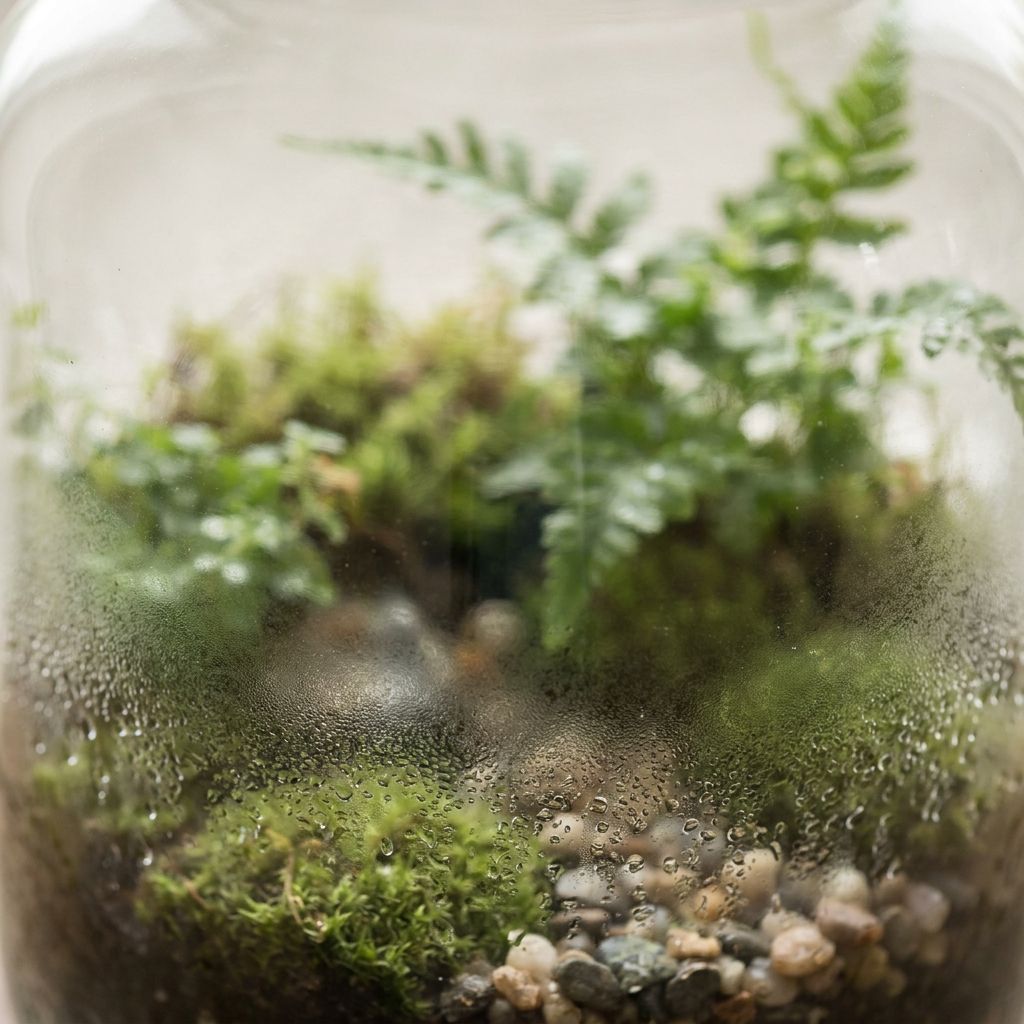
Closed terrariums planted with tropical species usually sit comfortably between 70 and 90 per cent humidity. A simple check with no kit: light misting on the lower third of the glass in the warm part of the day, then clear again overnight. Glass that streams without stopping means it is too wet.
No terrarium has one correct humidity, because it depends on what is growing inside. There is a usable range, though, and a free test that tells you most of what you need without buying anything.
The free test: look at the glass
A meter is not required to tell whether your terrarium is roughly right.
- Light misting on the lower third of the glass in the warmest part of the day, then clear again overnight. That is what a healthy closed terrarium looks like.
- More than half the glass wet, all day, not clearing. Too wet. Water may be pooling at the bottom.
- No condensation at any point in the day. Too dry, or the lid is not sealing properly.
That really is most of it. The glass is measuring it for you.
The numbers, if you would like them
For the tropical plants most closed terrariums are built around, 70 to 90 per cent humidity is a sensible band. Roughly, plant by plant:
- Mosses and selaginella prefer the top of that band and go crisp and pale quickly when they dry out.
- Fittonia, peperomia and small ferns sit comfortably through most of it, and are unhappy below around 60 per cent.
- Carnivorous plants vary enormously. Nepenthes and most sundews want it humid. Others want a drier, brighter, more open setup than a closed terrarium can give them.
- Succulents and cacti have no place in a closed terrarium. They want dry air, and a sealed jar cannot give them that.
If the planting spans more than one of those groups, no single humidity will suit all of it. That is a planting problem rather than a care problem, and it is worth fixing at the root.
Steady beats high every time
This is the point worth taking away.
A terrarium holding a steady 75 per cent is easier on plants than one that peaks at 95 per cent every afternoon and falls to 50 per cent overnight. Plants cope well with conditions. They cope badly when those conditions keep changing, and effort spent adjusting is effort not spent growing.
There is a small wrinkle here as well. Warm air holds much more moisture than cool air, so the same reading means different things at different temperatures. Sixty per cent on a cold morning is not the same experience for a leaf as sixty per cent on a warm afternoon.
Practical version: if you do use a meter, log it across a full day and night. One reading at lunchtime tells you very little.
Too wet is a genuine problem
Most advice treats humidity as something to push as high as it will go. It is not.
Very high humidity held for long stretches, with no air movement, brings trouble of its own:
- Water sitting on leaves instead of evaporating
- Soft, floppy growth that cannot hold itself up
- Mould, usually starting on dead leaf litter and spreading onto living tissue
- Roots sitting in substrate that stays soaked
If it is too wet: lift the lid off for a few hours. If it is badly waterlogged, leave it off for a full day. Take out any mouldy leaves or moss as soon as you spot them, rather than waiting to see if it spreads.
A closed terrarium with no air exchange at all is not a self-sustaining ecosystem. A little air movement belongs in a healthy one.
If you use a meter
- Put the sensor at plant level, not up near the lid where it will only read the condensation.
- Watch the shape across the day, not one number. A gentle rise and fall is fine. A cliff is not.
- Compare a day when you opened it with a day when you left it shut. That shows how much your own habits are moving things.
If humidity is in the right place and something still looks wrong, the leaves usually show where to look next. Start with what browning at the edges is telling you, since dry air is only one of four causes and the other three are easy to miss.
Holding a steady figure by hand is the fiddly part, and that is most of what the verdIQore terrarium system exists to take off you.
Related questions
Should my terrarium glass be foggy all the time?
No. In a healthy closed terrarium the lower third of the glass picks up a light mist in the warmest part of the day and clears again overnight. Glass that streams with water all day means it is too wet. Glass that does not fog at any point means it is too dry, or the lid is not sealing.
How often should I open a closed terrarium?
A well balanced one is opened very rarely, sometimes only when you prune. Let the glass tell you: heavy condensation that does not clear means a few hours with the lid off, or a full day if water is pooling at the bottom.
Do I need a humidity meter for a terrarium?
Not to get started. The way condensation sits on the glass already tells you most of what you need. A meter helps if you are chasing a particular plant or an unusual problem. In that case put the sensor at plant level and log it across a whole day rather than reading it once.
Can humidity be too high in a terrarium?
Yes. Very high humidity held for long stretches with no air movement causes mould, soft floppy growth and root rot. Holding steady in the middle of the range, with a little airflow, beats pushing for the highest number.
Why is there mould in my terrarium?
Usually too much moisture and too little air movement, and it normally starts on dead leaves or bits of debris. Take out anything mouldy as soon as you see it rather than waiting, then open the lid for a few hours so it can dry back.
Last updated 2026-08-26