Why are my plant leaves turning brown at the edges?
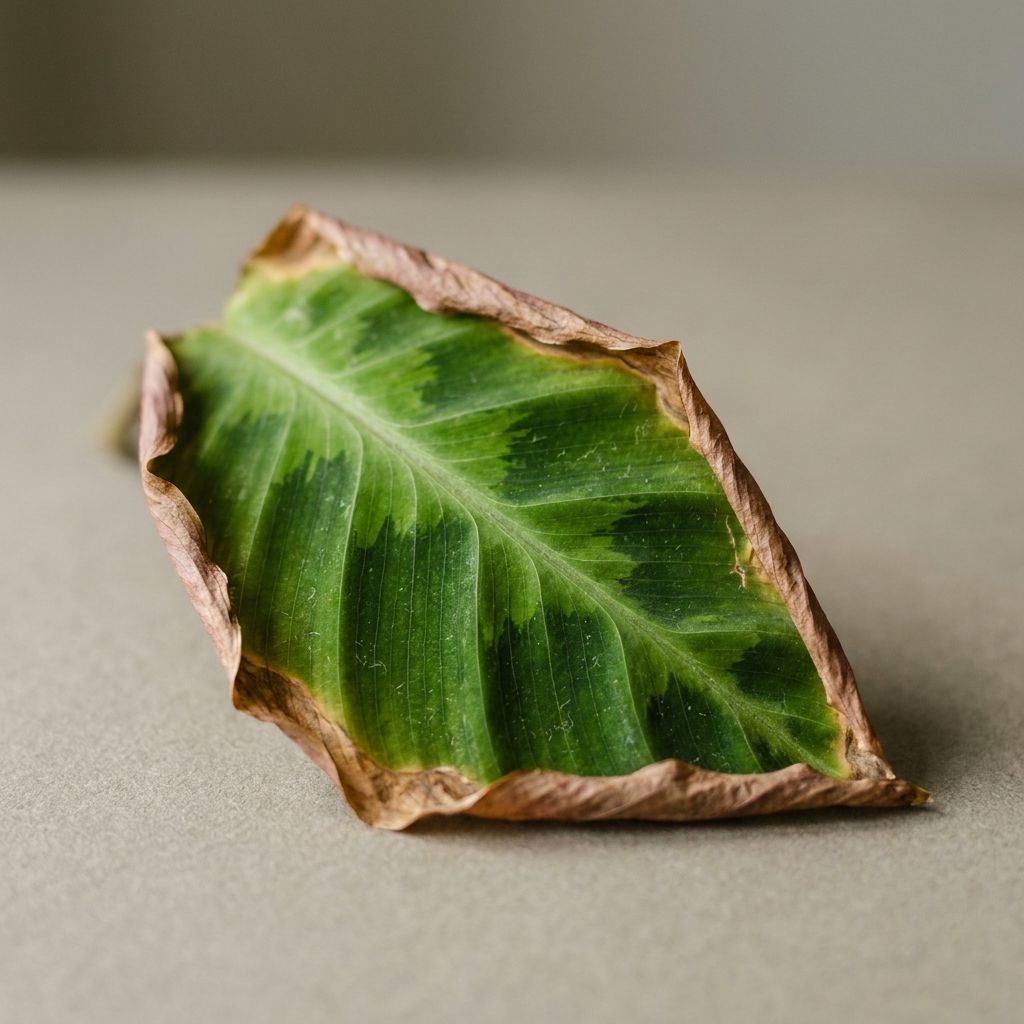
Crispy brown edges are almost always a water problem, though not always a watering problem. The four usual causes are dry air, letting the plant dry out between waterings, salt building up from too much feed, and chlorine or fluoride in tap water. Work through them in that order.
Brown, crispy edges are the single most common thing plant owners ask about. The good news is that the plant is telling you something quite specific. The frustrating part is that four different problems all look identical from across the room.
Here is how to work out which of them you have.
First: edge or middle?
Asking this one question saves most people a lot of wasted effort.
Browning that starts at the very edge or tip and works inward, leaving a dry, papery margin, is a water balance problem. The leaf is losing water faster than the plant can replace it. Everything below is about that.
Brown spots in the middle of a leaf, often with a yellow halo around them, belong to something else entirely. Usually that is water sitting on the foliage, or something the plant has picked up. Do not treat it as a humidity problem.
Whole older leaves going yellow and then brown, starting at the bottom of the plant, is often just the plant retiring old growth. That is normal and you can leave it.
The four usual causes, in order
1. The air around it is too dry
This is the most common cause, and homes run drier than most people realise, especially once the heating comes on for winter.
Tropical plants are the ones that suffer. Most of the popular ones grow on rainforest floors where the air sits somewhere around 60 to 90 per cent humidity. Fittonia, the nerve plant, is the classic canary here: it is usually recommended at 60 per cent and above, and in genuinely dry air it curls and browns at the margins quickly.
By way of comparison, a heated home in winter can sit at 30 per cent or lower. That is a big gap.
What helps: a humidifier, grouping plants together, a tray of damp pebbles, or moving the plant somewhere enclosed. A closed case holds moisture far better than a room ever will, and there is a practical humidity range worth aiming for rather than simply pushing it as high as possible.
2. You are letting it dry too far between waterings
Not underwatering exactly. Inconsistency. A plant that swings between soaking and bone dry will brown at the edges even if the total water over the week looks fine, because the roots keep losing contact with moisture and then getting flooded again.
What helps: water by how the soil feels rather than by the day of the week, and aim to keep it evenly moist rather than lurching between extremes.
3. Salt is building up in the pot
Fertiliser leaves salts behind. Feed a little too often, or a little too strongly, and those salts pile up until they start burning the leaf edges. If you can see a white or yellowish crust on the soil surface or around the drainage holes, this is almost certainly your answer.
What helps: flush the pot through with plenty of plain water, feed less often and more weakly, and repot into fresh soil if the build-up is bad.
4. Something in the tap water
Chlorine and fluoride in ordinary tap water can brown leaf tips over months, and some plants are far more sensitive than others. The usual sufferers are spider plants, dracaena, prayer plants, calathea and ti plants.
What helps: move the sensitive ones onto rainwater, filtered water or distilled water.
Steadiness matters more than a perfect number
Almost nobody mentions this part.
A plant sitting at a steady 70 per cent is generally happier than one that hits 85 per cent every afternoon and drops to 45 per cent overnight. Most plants do best when conditions stay reasonably still rather than swinging about daily.
There is a wrinkle as well. The same humidity reading does not feel the same to a plant at different temperatures. Warm air holds far more moisture than cool air, so 60 per cent on a chilly morning and 60 per cent on a warm afternoon are genuinely different experiences for the leaf. That is why a room that looks fine on the meter can still be hard work for the plant.
The practical version: measure across a whole day and night before you change anything. One reading at lunchtime tells you very little.
Do not overcorrect the other way
Very high humidity held for long stretches brings problems of its own, mainly fungal growth and rot. Air movement matters as much as moisture does. Somewhere steady in the middle of a plant’s range, with a little airflow, beats chasing the highest number you can reach.
What to do, in order
- Measure humidity across a full day and night, not once.
- Check the soil surface for a salty crust. If it is there, flush the pot.
- Think honestly about your watering pattern. Steady, or feast and famine?
- If your plant is on the sensitive list, try filtered water or rainwater for a month.
- Check the leaf is not resting against cold glass. Contact alone will mark it.
- Trim the dead edge off with clean scissors if you want to. It will not turn green again, but new growth will come in clean once conditions are right.
Change one thing at a time and give it a fortnight. Plants are slow, and changing four things at once means you learn nothing from any of them. Writing down what you changed and when makes this much easier, which is exactly what a plant journal is for: in six weeks you will not remember whether you switched the water or moved the pot first.
If several plants are struggling at once, it is often worth checking that they actually want the same conditions to begin with. Grouping plants by what they need solves more problems than any amount of adjusting does.
Related questions
Should I cut off the brown edges?
You can, and it will not hurt the plant. Use clean scissors and follow the leaf shape rather than cutting straight across. The cut edge will not turn green again, so this is only cosmetic. Fix the cause or the new growth will brown as well.
Will the brown parts turn green again?
No. Once leaf tissue has dried out and gone brown it is dead and will stay that way. What you want to see is new growth coming in clean. On a fast grower that shows within a few weeks. On a slow one it can take a season.
Is misting my plants enough to fix dry air?
Not really. Misting lifts humidity around the leaf for a few minutes and then it drops back. The steady level is what matters, so a humidifier, a tray of damp pebbles, grouping plants together, or an enclosed case will all do more than a spray bottle.
How do I know if it is tap water causing it?
Two clues. First, whether your plant is one of the sensitive ones: spider plants, dracaena, prayer plants, calathea and ti plants are the usual sufferers. Second, timing. Tap water damage builds slowly over months rather than showing up in a week. Try filtered water or rainwater for a month and watch the new leaves.
Can brown leaf edges mean I am watering too much?
Indirectly, yes. Soil that stays soggy damages roots, and damaged roots cannot move water up to the leaves, so the edges dry out even though the pot is wet. If your soil does not dry at all and the edges are browning, look at the roots before you add more water.
Last updated 2026-08-26